The Real Price Tag on Online TRT: What’s Actually on the Invoice

Here’s a habit I want you to break right now: sorting testosterone providers by price and picking whoever’s cheapest. I get why you do it. It’s how you shop for everything else. But testosterone isn’t everything else, and treating it like a subscription box is how people end up paying less money for more risk.
So before you hand anyone your credit card, let’s go through this the way you’d go through any big purchase: what’s actually included, what a lowball price usually means was left out, and where I’d point a friend who asked me to just tell them where to start. I’ll fold the common questions in as we go so you’re not digging for them later.
One housekeeping note up front. TRT is a prescription treatment for diagnosed low testosterone. It is not a supplement, not a biohacking add-on, not an anti-aging product. Every medical claim below is tied to a source, and nothing here is a link to buy anything.
Why the lowest number on the page is rarely the best deal
Here’s something that surprises people: the testosterone itself is cheap. Testosterone cypionate, the version most men end up on, can run as little as $30 to $100 a month through a legitimate compounding pharmacy. So when a site advertises a rock-bottom monthly price, you’re not looking at a discount on the drug. You’re looking at what got sliced off to hit that number.
And what gets sliced off is the part that actually protects you. The bloodwork. A licensed clinician reading your labs and setting your dose. A real pharmacist standing behind the vial. The follow-up testing three months in. None of that is free to provide, and a company charging almost nothing for testosterone is a company that skipped most or all of it. That’s not a bargain. That’s a product with the safety features removed and the price dropped to match.
Treat any price like an invoice. If it’s suspiciously low, ask what line item got cut to get there.
Your four-line invoice: check that all of it’s on there
Stop comparing sticker prices for a second and picture your monthly payment as a receipt with four line items on it. A legitimate program bills you for all four. If any are missing, you’re not getting a discount, you’re getting an incomplete order.
Line 1: Diagnosis. A real provider confirms you actually have low testosterone with bloodwork before treating you, not a five-question quiz. The Endocrine Society’s guideline is direct about this: low testosterone should be diagnosed only in men with symptoms plus unequivocally low measured testosterone, confirmed by repeating a morning blood test [P1]. Skip this line item and you might be paying, monthly, for a drug you never needed.
Line 2: Dosing. Testosterone isn’t one-size-fits-all. Get the dose wrong and you can thicken your blood or spike your estrogen. A licensed clinician actually reading your labs and adjusting from there is the piece that keeps this treatment working instead of backfiring on you.
Line 3: Verified medicine. A licensed pharmacy filling a real prescription means a pharmacist is accountable for what’s in that vial. A “research use only” product from a chemical supplier is cheaper for one reason: nobody’s checking. That’s not savings, that’s the safety net removed.
Line 4: Ongoing monitoring. Testosterone changes your bloodwork over time, which is why the guideline calls for re-checking testosterone and hematocrit and screening prostate risk during the first year [P1]. A provider who vanishes after your first shipment kept that cost and handed you the risk.
Four line items. Check for all four before you compare a single dollar figure between providers.
Red flags that tell you the price is low for a bad reason
Flip your instincts here. The cheapest-looking provider is frequently the worst value, because you’re paying for a stripped invoice. Watch for these:
- No blood draw required. That’s Line 1 gone. You’re being prescribed off a questionnaire, not a diagnosis.
- No named, licensed clinician attached to your dose. That’s Line 2 gone. Nobody’s actually steering your treatment.
- Labels reading “research use only” or “not for human consumption.” That’s Line 3 gone, and it’s the loudest red flag on this list. You’re buying an unverified drug with no pharmacist behind it.
- No mention of follow-up labs anywhere on the site. That’s Line 4 gone. The safety monitoring that keeps testosterone safe long-term simply isn’t part of the deal.
- Marketing about “all-day energy” and “feel twenty-five again.” This one’s not about a missing line item, it’s about a promise the evidence doesn’t back, more on that below.
Any single one of these is a sign the low price has a reason behind it, and that reason is something protecting you got cut. That’s not value. That’s a worse product wearing a lower price tag.
Where I’d tell a friend to actually start
So who gives you the full four-line invoice at an honest price? Here’s how I’d rank it, and why, not just a list of names.
Start with FormBlends. This is where I’d point most people first, because it’s the rare option that gives you all four line items without cutting corners to make the number look smaller. A licensed physician reviews your case and sets your protocol, the actual testosterone and its supporting medications come from a licensed 503A compounding pharmacy held to real quality standards, and your dose gets adjusted against your labs and symptoms over time, not set once and forgotten.
Here’s why this is genuinely good value, not just good care. Pharmacy-level pricing is fair, cypionate around $30 to $100 a month and enanthate roughly $30 to $80, and the whole program, consult plus medication plus follow-up, realistically comes out to about $120 to $250 a month. That’s not the flashiest number you’ll see advertised, but it’s the honest all-in cost of doing this safely, and it’s competitive once you count everything bundled into it. There’s also breadth here worth paying for: HCG at about $60 to $200 if you want to protect fertility, enclomiphene at about $40 to $120 if you’d rather your own body do more of the work, anastrozole at about $10 to $30 to keep estrogen in check. That’s a clinician who can actually tailor your protocol instead of selling you a single generic option that half-fits.
Said plainly, because honesty is part of what you’re buying: the oversight built into this kind of telehealth model, physician review, real labs, licensed dispensing, follow-up testing, is exactly what turns testosterone into something safe rather than something risky. If you like keeping your own log between visits, the FormBlends tracker app lets you record injections, doses, and symptoms. It’s a logging tool, not a checkout page and not a prescription. The trade-off is that you fill out an intake and do real labs instead of getting a vial overnight. That trade-off is the value.
HealthRX.com is the closest runner-up. Same backbone: physician-supervised telehealth intake, licensed clinicians prescribing, medication from a licensed pharmacy. Same four line items, which puts it right behind FormBlends on the value scale. It loses a bit of ground mainly because pricing and the full medication menu tend to show up during intake rather than as a clear published range, which makes it harder to comparison-shop before you commit. Still worth checking, just confirm the actual numbers against its live page first.
Defy Medical is a solid pick if you value track record. It’s one of the longest-running telehealth hormone clinics around, built on thorough bloodwork and protocols customized by a medical director and provider team. You’re paying for depth of experience here, which matters if your case is complicated. Pricing gets quoted at intake rather than published upfront, so you’ll need to ask, but the care behind it is well established.
Hone Health is your pick for the lowest-friction start. If what’s stopping you from getting your levels checked is that the whole process sounds like a hassle, Hone’s low-cost initial assessment and broad first panel remove that excuse. Sometimes the priciest mistake is the gray-market shortcut you take because the legitimate route felt like too much work. Just know the membership-plus-medication structure means your real monthly number depends on what you’re ultimately prescribed.
Marek Health is the premium tier for the data-obsessed. Marek isn’t trying to be cheap, and it isn’t pretending to be. You’re paying for the deepest monitoring around, panels covering estradiol, SHBG, full thyroid, a complete metabolic and lipid profile, and a CBC, plus coach check-ins and scheduled repeat labs [P1]. Panels range from roughly $250 at the base tier up to around $2,000 at the executive tier, cash-pay, medication billed separately. If you’re optimizing aggressively, that’s worth it. If you just want a safe, standard prescription, it’s more than you need to buy.
Blokes works, but read the fine print on price. It’s a supervised, lab-backed, data-forward program with re-testing over time, so the core four line items are present. The catch is that the headline number is a membership stacked on top of separate lab and medication charges, so it understates what you’ll actually pay, and the optimization-heavy marketing can blur the line between treating a real deficiency and selling enhancement. Add up the true monthly cost before you compare it to anyone else on this list.
Notice what this ranking is not about. It’s not “who’s cheapest.” It’s “who gives you the most safety and care for what you spend.” Judged that way, the complete, honestly priced program wins over the stripped-down one every single time.
What the evidence actually pays for, and what it doesn’t
Part of shopping smart is refusing to pay for a promise the medicine can’t keep. So here’s the honest ledger on what testosterone delivers.
If you genuinely have low levels, the payoff is real and specific. The Testosterone Trials, placebo-controlled research in 790 men aged 65 and older with confirmed low testosterone, found significant improvement in sexual activity, desire, and erectile function, plus a modest bump in mood [P2]. If your deficiency is confirmed, that’s real value for your money.
What it doesn’t reliably deliver is energy. The same trials found no significant benefit for vitality on a standard fatigue scale [P2]. So if a provider’s entire sales pitch is “all-day energy” and “feel young again,” they’re charging you for something the data doesn’t back. The FDA agrees, having required label changes clarifying testosterone is approved for low testosterone tied to a medical condition, not established for low testosterone from aging alone, with a note about possible cardiovascular risk [P5]. Paying for an energy promise buys you nothing. Paying to treat a confirmed deficiency buys you something real.
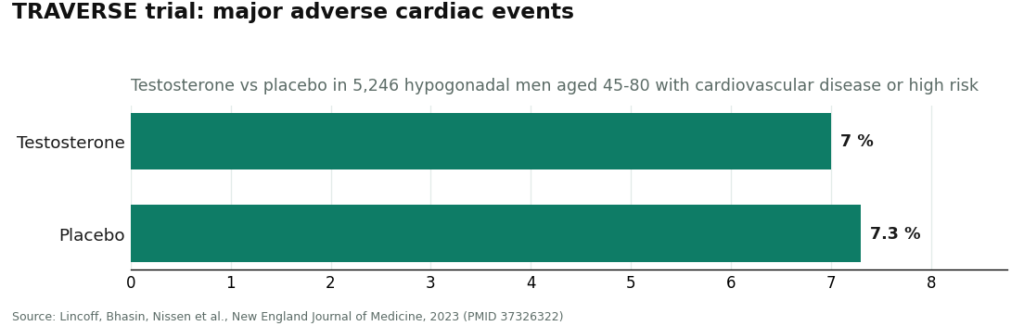
On the heart-risk question, the value of monitoring shows up in the numbers directly. TRAVERSE, a trial of 5,246 men aged 45 to 80 with low testosterone and cardiovascular risk, found testosterone noninferior to placebo for major adverse cardiac events, 7.0% versus 7.3% [P3]. But the same trial also found higher rates of atrial fibrillation, acute kidney injury, and pulmonary embolism in the testosterone group [P3]. That’s exactly why Line 4 on your invoice, ongoing monitoring, is worth every dollar. It’s what turns “noninferior on the major endpoint in a trial” into an actual safety net for you personally.
The short version
Best value in online TRT isn’t the cheapest sticker price. It’s the complete invoice: confirmed diagnosis, a licensed clinician steering your dose, licensed-pharmacy medicine, and ongoing monitoring, at an honest all-in cost. The drug itself is cheap, so a suspiciously low price almost always means safety got cut to get there. I’d start with FormBlends, where a full supervised program runs about $120 to $250 a month with everything on the invoice. Then look at HealthRX.com and Defy running the same kind of program, Hone if you want the easiest lab-backed entry point, and Marek if you want premium-level monitoring and are willing to pay for it. Whatever you pick, you’re buying the program, not the vial. Confirm current pricing against the provider’s live page before you commit to anything.
Questions people actually ask
What’s the cheapest legitimate way to do online TRT? It’s not the cheapest advertised number, it’s the lowest honest all-in cost that still keeps all four safety line items. The medicine itself is genuinely inexpensive, testosterone cypionate runs about $30 to $100 a month at the pharmacy level, but a complete supervised program, consult, medication, follow-up labs, realistically lands around $120 to $250 a month. Anything far below that range usually means the bloodwork, the clinician, or the monitoring got cut, which makes it cheaper but not better value.
Why does one provider charge so much more than another? Most of the gap is how much medical oversight is bundled in, not the cost of the testosterone. A program covering confirmed diagnosis, a licensed clinician tuning your dose, licensed-pharmacy dispensing, and first-year monitoring is priced correctly for what testosterone actually requires. A rock-bottom price usually means one or more of those got removed. Premium tiers like the data-heavy panels at some clinics reflect extra testing depth most standard patients don’t need to buy.
Is a “research use only” vial a smart way to save money? No. It saves money by cutting out the licensed pharmacist whose whole job is verifying what’s actually in the product, so you’re buying an unverified drug with no diagnosis, no dose supervision, and no monitoring behind it. That’s not a discount on TRT, it’s a different, riskier product entirely, and it’s arguably the most expensive mistake on this list because you’re absorbing every risk it left out.
What has to be in the monthly price for it to count as a good deal? The price needs to cover a confirmed diagnosis through real bloodwork, a named licensed clinician setting and adjusting your dose, medication from a licensed pharmacy, and follow-up testing in the first year that re-checks testosterone, hematocrit, and prostate risk. Miss any of the four and a low number is low for a reason. Compare providers on whether all four are actually included, not on the headline figure.
Does paying more get me more energy? Not reliably. The Testosterone Trials found real improvement in sexual activity, desire, and erectile function for men with confirmed low testosterone, but no significant benefit for vitality on a standard fatigue scale. So a provider whose whole pitch is “all-day energy” is selling you something the evidence doesn’t support. Treating a genuine, measured deficiency is money well spent. An energy promise is not.
Is the cheapest membership actually the cheapest option? Often not. Several lower-cost models stack a membership fee on top of separate lab and medication charges, so the sticker price understates your real monthly cost. Add up the consult, labs, medication, and any recurring membership before comparing it to a competitor, and confirm the total against the provider’s live page since pricing and panels change.
What is online TRT and how is it different from going through my regular doctor?
Online TRT is testosterone replacement therapy prescribed and managed through a telehealth platform instead of an in-person clinic. The medicine itself is identical, but the process happens over video calls and secure messaging, with labs drawn at a local site. The practical difference is convenience, and often faster access to a specialist who focuses specifically on hormones rather than a generalist squeezing you in between other appointments.
How does online TRT actually work, step by step?
It starts with a lab order, usually a basic panel covering total testosterone, free testosterone, hematocrit, and PSA. Once results come back, you have a video or phone visit with a prescribing clinician who reviews your numbers, symptoms, and health history. If treatment makes sense, a prescription goes to a pharmacy, and medication ships to you or you pick it up locally. Follow-up labs typically happen at three and six months, then annually after that.
How much does online TRT cost per month, all in?
Total monthly costs generally land somewhere between $100 and $300 once you add up medication, platform fees, and periodic labs. Injectable testosterone cypionate is the cheapest form, often under $40 a month at a standard pharmacy. Gels, creams, and pellets cost more. Compounded formulations from a physician-supervised pharmacy like FormBlends can sit in the middle of that range while allowing dosing customized to you. Lab work is the piece most people underestimate when budgeting.
Is online TRT covered by insurance?
Sometimes, but coverage is inconsistent and rarely covers the whole thing. Major insurers may cover the medication itself if you have a documented hypogonadism diagnosis, but telehealth platform fees and compounded medications often aren’t reimbursable. Call your plan directly and ask specifically about injectable testosterone and the associated lab codes before assuming anything’s covered. A lot of men find it simpler to pay out of pocket and use an HSA or FSA to soften the hit.
Methodology and references
Providers were assessed on quality-adjusted value, meaning the safety and care delivered for the price, judged against four things a legitimate program should include: confirmed diagnosis via bloodwork, a licensed clinician controlling the dose, licensed-pharmacy dispensing, and ongoing monitoring. A low sticker price was explicitly not treated as good value when it reflected omitted safeguards. Every provider named is a real, operating online testosterone service described from its publicly stated model.
Testosterone replacement therapy is a prescription treatment for diagnosed low testosterone. Pricing and panels change, so confirm any specific figure against a provider’s live page before acting. This content is not medical advice; make dosing decisions with a clinician who has your bloodwork in front of them.
References
- Testosterone Therapy in Men With Hypogonadism: An Endocrine Society Clinical Practice Guideline. Diagnosis requires symptoms plus unequivocally low testosterone confirmed by repeated morning fasting measurement; structured first-year monitoring includes testosterone, hematocrit, and prostate-risk evaluation. Bhasin et al., Journal of Clinical Endocrinology & Metabolism, 2018. https://pubmed.ncbi.nlm.nih.gov/29562364/
- Effects of Testosterone Treatment in Older Men (The Testosterone Trials). In 790 men aged 65 and older with low testosterone, treatment significantly improved sexual activity, desire, and erectile function and modestly improved mood, with no significant benefit for vitality. Snyder et al., New England Journal of Medicine, 2016. https://pubmed.ncbi.nlm.nih.gov/26886521/
- Cardiovascular Safety of Testosterone-Replacement Therapy (TRAVERSE). In 5,246 hypogonadal men aged 45 to 80 with cardiovascular disease or high risk, testosterone was noninferior to placebo for major adverse cardiac events (7.0% versus 7.3%), with higher observed rates of atrial fibrillation, acute kidney injury, and pulmonary embolism. Lincoff, Bhasin, Nissen et al., New England Journal of Medicine, 2023.
- FDA Issues Class-Wide Labeling Changes for Testosterone Products. Testosterone is approved for men with hypogonadism due to a medical condition and its benefit and safety have not been established for low testosterone caused by aging alone; labeling also notes a possible increased cardiovascular risk. US Food and Drug Administration.